
Dough Calculator
Scale any dough recipe with baker's percentages. Choose how many pizzas or loaves you want and how heavy each should be, set hydration, salt, yeast and oil, and get exact weights of every ingredient — plus a quick check on how the dough will feel.
- Free to use
- No sign-up
- Runs in your browser
Calculate dough ingredients
Dough Formula Workbook
A baker's percentage workbook with pizza and bread formulas, a fermentation schedule planner and a bake log.
- Baker's percentage workbook (XLSX, PDF)
- Formula reference (PDF, XLSX)
- Bake log (PDF, DOCX)
Formats: XLSX, PDF, DOCX. Instant download after payment (link valid 72 hours, up to 5 downloads). AI-assisted: the templates were drafted with AI help and reviewed and laid out before publishing.
$4.00 USD, one-time 3 files · about $1.33 each
- Instant download
- 7-day refund
- Secure checkout by Stripe
7-day money-back guarantee. Full refund within 7 days of purchase, even after you download.
Full refund within 7 days — see the refund policy and license.
Free printables
Single sheets you can print right now, no sign-up. The full pack adds every sheet in one download plus the editable files.
What baker's percentages are
Bakers write recipes as percentages of the flour weight, with flour always at 100%. A dough with 1,000 g of flour and 650 g of water is 65% hydration; 28 g of salt is 2.8%. This makes recipes easy to scale and compare: whatever the batch size, the ratios stay the same. It also explains dough behaviour at a glance — a 75% hydration dough will be much wetter than a 60% one, whatever the quantity.
How the calculator works
- Total dough needed = number of balls × weight of each (plus a little for what sticks to the bowl).
- Add up all the percentages: flour 100% + water + salt + yeast + oil + sugar.
- Flour = total dough ÷ total percentage × 100.
- Every other ingredient = flour × its percentage.
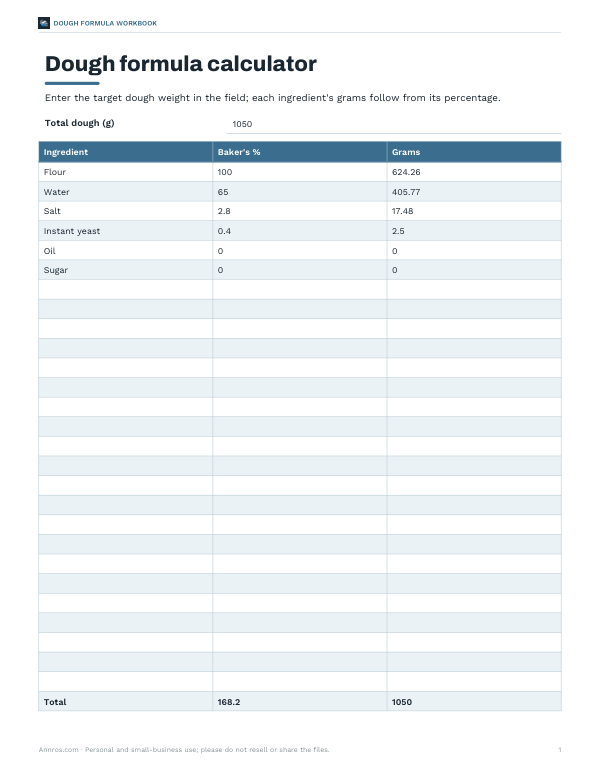
For example, with 65% water, 2.8% salt and 0.4% yeast the total is 168.2%. Four 260 g balls plus 1% extra make 1,050 g of dough, so flour is 1,050 ÷ 168.2 × 100 = 624 g; water 406 g; salt 17.5 g; yeast 2.5 g.
Typical formulas
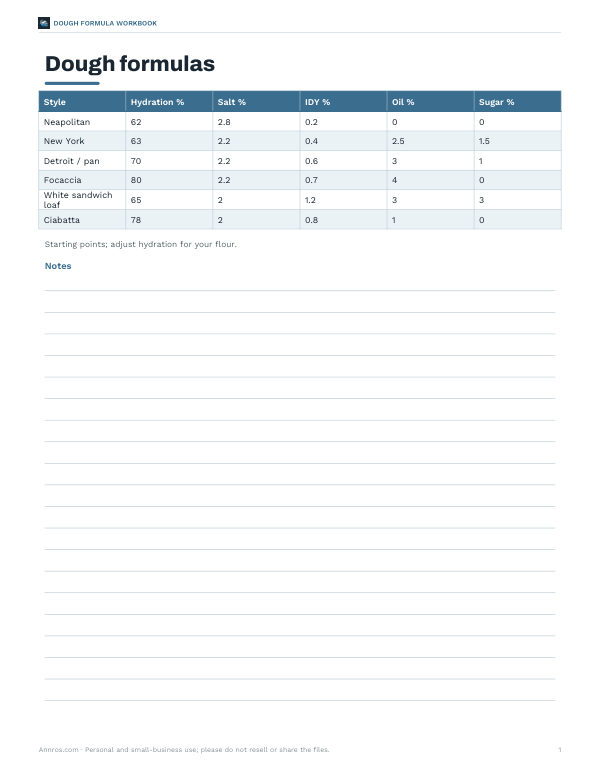
| Style | Hydration | Salt | Yeast (IDY) | Oil | Sugar | Ball / loaf |
|---|---|---|---|---|---|---|
| Neapolitan pizza | 60–65% | 2.5–3% | 0.1–0.3% (long ferment) | 0 | 0 | 250–280 g |
| New York pizza | 60–65% | 2–2.5% | 0.3–0.5% | 2–3% | 1–2% | 280–400 g |
| Pan / Detroit style | 65–75% | 2–2.5% | 0.5–1% | 2–5% | 0–2% | By pan size |
| Focaccia | 75–85% | 2–2.5% | 0.5–1% | 3–5% + pan oil | 0 | By pan size |
| Basic white loaf | 62–68% | 1.8–2% | 1–1.5% | 0–3% | 0–4% | 500–900 g |
| Ciabatta | 75–80% | 2% | 0.5–1% | 0–2% | 0 | 300–500 g |
Choosing hydration
Higher hydration gives a more open, airy crumb and a crisper crust in a hot oven, but the dough is stickier and harder to shape. Strong bread flour and many Italian 00 pizza flours absorb more water than all-purpose flour; whole-wheat flour absorbs more still, often needing 5–10% more water. If you are new to a style, start at the lower end of its range and increase by 2% at a time as your handling improves.
Yeast types and amounts
Instant dry yeast is the reference in the calculator. Active dry yeast is less concentrated; use about 25% more. Fresh (cake) yeast is much less concentrated; use about three times the instant amount. Fermentation time and temperature matter as much as quantity: a same-day pizza dough at room temperature might use 0.5–1% instant yeast, while a 24–72 hour cold ferment in the fridge might use 0.1–0.4%. Less yeast and more time generally mean more flavour.
Worked example: four Neapolitan-style pizzas
For four 260 g balls at 65% hydration, 2.8% salt and 0.4% instant yeast, the calculator gives about 624 g flour (00 or strong bread flour), 406 g water, 17.5 g salt and 2.5 g instant yeast. Mix, knead until smooth, rest for an hour, divide into four balls, and cold-ferment in a covered container for 24–48 hours. Bring to room temperature for a couple of hours before stretching.
Tips for better dough
- Use a digital scale accurate to 1 g, and a small jewellery scale (0.01 g) for yeast in small batches.
- Dissolve or disperse yeast in the water, and add salt after the flour has absorbed some water.
- Use cool water in warm kitchens to slow fermentation; warm water in cold kitchens.
- Rest the dough (autolyse) for 20–30 minutes after mixing flour and water to make kneading easier.
- Let dough balls come to room temperature before stretching; cold dough tears.
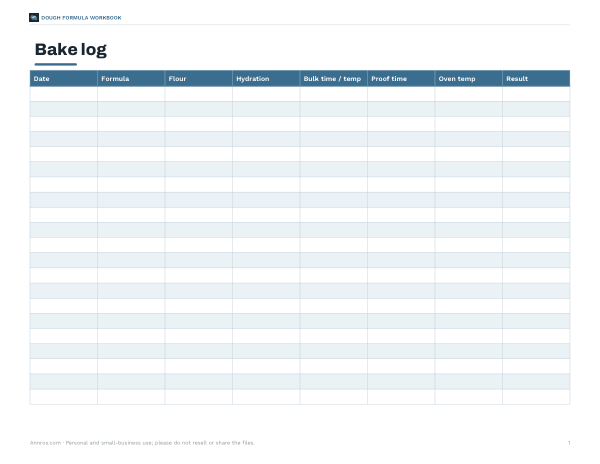
- Keep a notebook of flour, hydration, times and results.
Converting a recipe to baker's percentages
To analyse a recipe you already like, divide each ingredient's weight by the flour weight and multiply by 100. A recipe with 500 g flour, 350 g water, 10 g salt and 7 g yeast is 70% hydration, 2% salt and 1.4% yeast. If a recipe gives cups, weigh one cup of your flour as you normally scoop it — often somewhere around 120–140 g — to convert. Once in percentages, you can scale it with the calculator to any number of loaves or pizzas.
Frequently asked questions
What is 65% hydration?
Water weighs 65% of the flour weight — for example 650 g water to 1,000 g flour.
How much dough for a 12-inch pizza?
Roughly 250–280 g for a thin Neapolitan style; 300–350 g for a slightly thicker New York style.
Can I use all-purpose flour?
Yes, but it absorbs less water than bread or 00 flour; reduce hydration by a few percent.
How do I convert active dry to instant yeast?
Use about 25% more active dry yeast than instant, or 20% less instant than active dry.
Does salt percentage include the salt in toppings?
No, it is only the salt in the dough.
Why is my dough too sticky?
The hydration may be high for your flour or your handling; lower it by 2–3% or use folds and wet hands.
How long should pizza dough ferment?
Same-day doughs rise for a few hours at room temperature; cold-fermented doughs develop more flavour over 24–72 hours in the fridge with less yeast.
Can I freeze dough balls?
Yes. Freeze them after the first rise in lightly oiled, airtight bags, then thaw overnight in the fridge and bring to room temperature before shaping.